
Your Heart's Electrical Blueprint: Understanding the ECG Wellness Scan
A visual guide to the five core wellness metrics, the ECG advantage over wrist sensors, and how to read your score range — all in one page.
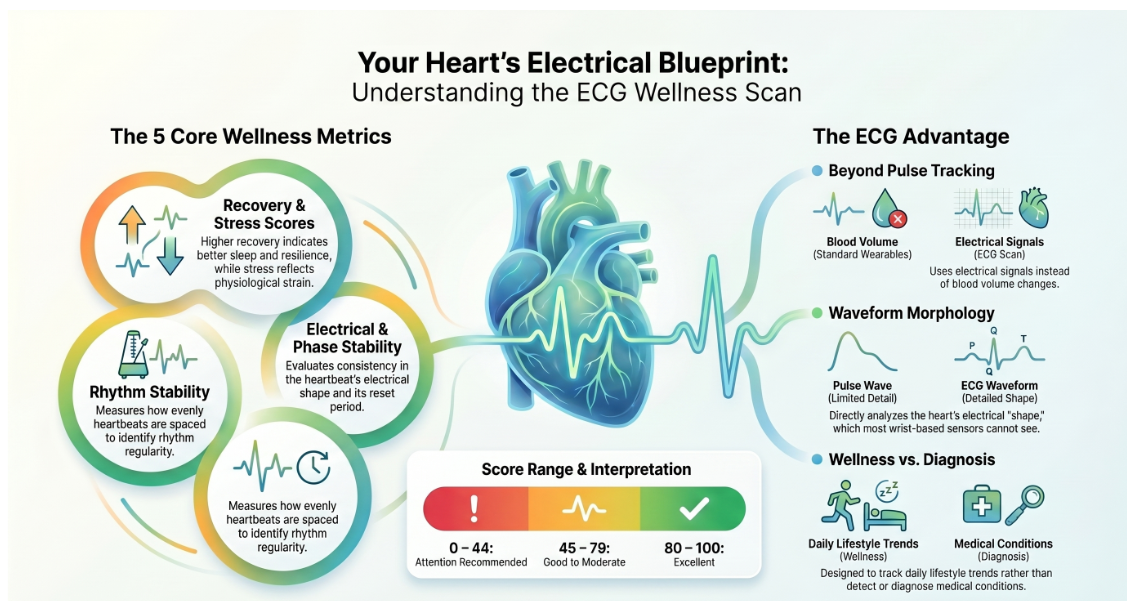
Wrist-based wearables count beats by watching blood volume change under your skin. An ECG watches the actual electrical signal that drives every heartbeat. That difference — pulse versus voltage — is why an ECG wellness scan can see things a smartwatch simply cannot.
The five core wellness metrics
Every scan distils your recording into five scores between 0 and 100. Together they give you a snapshot of how recovered, calm, and electrically steady your heart looks today.
- Recovery & Stress Scores — higher recovery means better sleep and resilience; higher stress reflects physiological strain.
- Rhythm Stability — measures how evenly your heartbeats are spaced, flagging irregular patterns.
- Electrical Stability — checks whether each heartbeat waveform looks consistent from beat to beat.
- Phase Stability — evaluates the heart's electrical reset period (the recovery phase between beats).
The ECG advantage
Beyond pulse tracking. Standard wearables infer your heartbeat from blood volume changes. An ECG scan reads the electrical signal directly — the same kind of signal a hospital uses.
Waveform morphology. A pulse wave is a smooth bump. An ECG waveform has a distinct P, Q, R, S, T shape — and the geometry of that shape carries information about rhythm, conduction, and recovery that wrist sensors can't see.
Wellness vs. diagnosis. This scan is designed to track daily lifestyle trends — stress, recovery, rhythm steadiness — not to diagnose medical conditions. For anything clinical, see a cardiologist.
How to read your score
- 0–44 — Attention recommended. Worth a closer look, especially if it persists across multiple clean recordings.
- 45–79 — Good to moderate. A normal range for most people on most days.
- 80–100 — Excellent. Your heart looks well-recovered, steady, and electrically clean.
One scan is a snapshot. Repeating scans under similar conditions — same time of day, same posture, same caffeine status — is how you build a real baseline.
Want the full breakdown of each score and the HRV metrics behind them? Read the detailed report guide →
Get your heart checked at home
A trained technician brings a portable ECG to your home in Chandigarh Tricity. 10 minutes, ₹999, a full report with interpretation.
Keep reading
ECG Test Cost in India: 2025 Price Guide
What you actually pay for an ECG in India — hospital vs lab vs at-home — and how to know if it's worth it.
Silent Heart Attack Symptoms You Shouldn't Ignore
Up to 1 in 5 heart attacks are silent — no crushing chest pain, no dramatic collapse. Here's what to watch for.
How to Prevent a Heart Attack: 9 Things That Actually Work
Forget miracle supplements. Here are the changes that genuinely cut your heart attack risk, backed by the research.